
Image courtesy of TCGdex.net
For Pokémon TCG collectors and strategists alike, the small green Caterpie from the Generations line is a delightful case study in rarity distribution that blends nostalgia with data-driven insights. This card, a Basic Grass-type with the modest 40 HP, is more than a cute symbol of early trainer days—it’s a lens into how print runs, variant availability, and price movements influence both collecting goals and deck-building ambitions. In this article, we’ll dissect Caterpie’s distribution across variants, examine the market signals currently shaping its value, and imagine practical ways to weave this common Pokémon into modern collection plans and play strategies ⚡🔥.
Rarity, variant footprints, and what “Common” really means in Generations
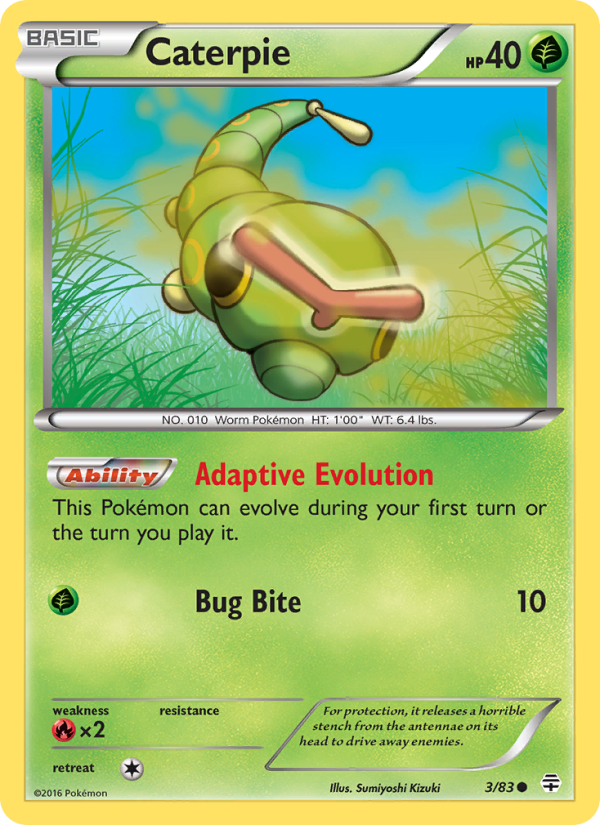
Within the Generations set, Caterpie carries the rarity tag commonly understood as “Common.” Yet rarity alone doesn’t tell the whole story. The card’s official print count sits within a larger universe: the Generations set comprises 83 official cards and a total of 117 printings across all variants. For Caterpie (dexId 10, g1-3), you’ll find multiple print variants—normal, reverse holo, and holo—each offering a different collectible presence, even though the base rarity remains common. The absence of a first edition designation on this running print further clarifies a modern collector’s landscape where a holo copy can exist side-by-side with a non-holo for far different values and display appeal.
Artistically, Caterpie’s illustration is credited to Sumiyoshi Kizuki, whose work in Generations evokes a bright, honeyed nostalgia that matches the card’s youthful, learning-to-evolve ethos. The G1 Generations era itself is a celebration of Pokémon’s journey from the earliest days into a broader, more polished era of the TCG. The “Adaptive Evolution” ability on this Caterpie—an unusual mechanic for a Basic Pokémon—allows evolutions to occur during your first turn or the turn you play it. That kind of timing creates a unique distribution dynamic: while Caterpie remains a common staple on tables, the ability to accelerate evolution on the first turn introduces a subtle volatility in how players value early-stage play, even for a commonly printed card.
From a purely distribution-centric angle, holo prints tend to command higher visibility in markets, often driving interest among players who prize aesthetics and display value. The normal and reverse holo variants keep Caterpie approachable for budget collectors who want a complete Generations experience without paying a premium for a holo version. This multi-variant availability mirrors broader TCG economics, where holo rarity tends to raise perceived rarity and price, even for cards that share common core stats.
Market signals: price, trends, and where Caterpie sits in value dashboards
Current pricing data paints a clear picture: standard non-holo Caterpie cards in Generations hover in the more accessible range, with CardMarket averages around 0.1 EUR and a low watermark near 0.02 EUR. In contrast, holo copies, while still affordable by modern standards, sit distinctly higher—average holo valuations hover around 0.56 EUR, with upward trends reflected in metrics like a 0.61 trend and a 0.87 average over a 30-day window. These numbers aren’t just numbers; they map a collector’s journey: a casual set could begin with a budget-friendly non-holo as a display piece, while a dedicated enthusiast might chase holo variants to round out a Generations collection with a stronger, shinier flagship. The data also hints at supply dynamics. With the Generations set’ near-70-card footprint in common print runs and a relatively modest total print count for the entire line, holo copies become “scarce-by-variant” relative to their non-holo siblings. That scarcity, paired with nostalgia and the lure of a well-kept display, helps explain why holo Caterpie keeps pulling interest from investors and casual collectors alike. The evolving price signal—especially the holo trajectory—carries implications for how people value the early evolutions in a Grass-type deck, and how they budget their chase for the Generations’ art and printing history.
For players who lean into theorycrafting, Caterpie’s Attack, Bug Bite, deals only 10 damage, and its weakness to Fire makes it vulnerable in certain metagames. Yet its practical value lies less in raw damage and more in timing and progression. The combination of a low HP pool (40) and a high-clarity path to stronger evolutions creates a narrative where Caterpie serves as a tempo accelerant rather than a finisher. In a well-constructed deck, you can leverage Adaptive Evolution to get your grass synergy moving fast, while Reserve or Rare Candy options step in to complete your evolution chain at the right moment. This balancing act is a microcosm of rarity distribution analytics: a common card can be both a budget entry and a strategic accelerator depending on how you layer your deck and your collection goals.
Strategy spotlight: collecting with a purpose and playing with intent
“Rare isn’t just about the shiny card in your binder; it’s about the story the print tells and the role it plays in a deck’s tempo.”
For collectors: Caterpie’s multi-variant availability makes it a perfect specimen for a Generations-focused display. Consider building a mini-gallery that juxtaposes normal, reverse holo, and holo copies, annotated with their relative prices, estimated print runs, and illustrated by Sumiyoshi Kizuki. The contrast between holo’s brightness and the understated charm of the non-holo can be a tangible demonstration of how rarity distribution translates into aesthetic value and collector psychology. If you’re chasing holo completeness, budget for the holo while keeping a non-holo’s charm as a baseline, and use the CardMarket trend data to time purchases when the holo market cools slightly for a more balanced investment. For players and deck builders: Caterpie’s Adaptive Evolution is a quirky reminder that early evolutions can be” fast-tracked” in specific turn windows. In practice, you could leverage Caterpie as a tempo-setting poke that grabs early board presence, enabling you to set up a stronger mid-game engine using later evolutions and additional Grass-type allies. While Bug Bite is modest on its own, the card’s position in a Generations-era Grass toolkit has a nostalgic resonance—balanced by modern-day price signals that favor holo variants as pieces of a curated vintage collection as much as playable, budget-friendly staples.
Art, heritage, and the allure of Generations
The Generations set is a love letter to fans who grew up alongside the franchise’s early triumphs and trials. Caterpie, with Sumiyoshi Kizuki’s bright, approachable art, captures that sense of wonder perfectly. The card’s creature design—humble, green, and endlessly evolving—complements the set’s celebratory mood. For fans who appreciate the art’s story as much as its game play, Caterpie offers a tangible link to a time when Pokémon was a simpler, more exploratory adventure. The rarity distribution analytics behind Caterpie isn’t just about price points; it’s about how a single card can anchor a collector’s journey through art, memory, and the evolving language of the Pokémon TCG economy ⚡🎨.
Clear Silicone Phone Case Slim Durable Protection 1More from our network
- https://blog.digital-vault.xyz/blog/post/bp-rp-color-index-about-013-reveals-a-distant-hot-star/
- https://blog.digital-vault.xyz/blog/post/humor-shapes-play-experience-with-irresistible-prey-in-mtg/
- https://blog.digital-vault.xyz/blog/post/cultural-influences-behind-combat-threshers-art/
- https://blog.digital-vault.xyz/blog/post/turn-real-world-problems-into-a-marketable-digital-product/
- https://crypto-acolytes.xyz/blog/post/top-minecraft-star-wars-mods-for-epic-space-battles/